
R Ashwin is a content man after becoming only the second Indian to take 500 Test wickets and has no interest in chasing Anil Kumble's national record of 619 scalps.

In the context of RBI's view that the real interest rate, defined as the repo rate less "look forward" CPI, should be around 150-200 basis points.

'While foreign institutional investor flows are still negative, they will turn positive in the latter part of 2023 as India's resilient growth becomes perceptible.'

At $2.6 trillion, the Indian economy is currently ranked sixth in the world behind the US, China, Japan, Germany and the UK.

The equity cult has grown at a rapid pace in India in the last few years, with retail investors latching on to the stock markets like never before. At 126.6 million, the number of dematerialised (demat) accounts, where investors hold their securities in electronic form for trading purposes, are at record high levels. The growth rate, on an annualised basis, stood at 27 per cent in 2022-2023, up from barely 6 per cent a decade ago.

...close to the 2024 general election. The BJP calling the Congress 'seasonal Hindu' is as laughable as the saffron party sparing itself the title of 'seasonal extreme Hindu.'
How else should one describe its election campaigns of the past years?
It was typically obsessive religion and personality cult with economic development for fig leaf, asserts Shyam G Menon.

The Rajya Sabha on Tuesday gave its green light to the Multi-State Cooperative Societies (Amendment) Bill 2023. This Bill introduces significant amendments to the Multi-State Cooperative Societies (MSCS) Act. These modifications aim to enhance the transparency and accountability of these cooperatives' operations in a bid to improve governance.

The International Monetary Fund (IMF) has said India and China will account for half of the global economic growth in 2023, as the multilateral agency retained its growth forecast for Asia's third-largest economy for 2023-24 (FY24). "India remains a bright spot. Together with China, it will account for half of global growth this year, versus just a tenth for the US and euro area combined," the IMF said in its latest update to the biannual World Economic Outlook. Growth in India is set to decline from 6.8 per cent in 2022 (FY23) to 6.1 per cent in 2023 (FY24) before picking up to 6.8 per cent in 2024 (FY25), the global lender said while citing "resilient domestic demand despite external headwinds".

India has not made the giant leap that was needed.

'We are working with a few housing finance companies to drive affordable lending because that's where we believe our sweet spot is.'

'In terms of semiconductors, challenges do remain in the pan industry, but I think we are much better than where we were a year or so back.'

Mutual funds (MFs) are betting on a turnaround in the healthcare sector to boost returns but are divided on the prospects of the information technology (IT) sector amid uncertain growth outlook. At the end of June, all of the top 20 fund houses were overweight on the healthcare sector vis--vis the sector's presence in the BSE 200 index, shows a report by Motilal Oswal Financial Services (MOFS). In the case of the IT sector, only six of the 20 fund houses had overweight positions.


'It has taken us 15 years to get to where we are. It obviously doesn't happen overnight.'

The International Financial Services Centres Authority (IFSCA) has proposed key exemptions to the current listing framework and measures for setting up holding companies (holdcos) and special purpose acquisition companies (SPACs) to encourage domestic startups list at GIFT City, the country's only international financial services centre (IFSC). Under the current framework, to be eligible to list on IFSC exchanges, an issuing company should have operating revenue of at least $20 million in the preceding financial year and average pre-tax profits of at least $1 million during the preceding three financial years. An expert committee has noted these conditions have acted as hurdles to listing new-age companies, and they need a relook.

Though India is a low-bandwidth geography with relatively low Internet penetration, it has a very large number of sophisticated surfers and skilled computer users

Indian companies are planning to increase investments in the new year to expand capacity, acquire companies, and go on a hiring spree, a survey of top executives showed. They, however, cited rising costs, weak consumer demand, and increasing interest rates as major concerns for 2023 which may impact their plans.

The growth momentum in India's manufacturing sector was maintained in February, with new orders and output increasing at similar rates to January, according to a monthly survey. The seasonally adjusted S&P Global India Manufacturing Purchasing Managers' Index (PMI) was at 55.3 in February, little-changed from 55.4 in January. The February PMI data pointed to an improvement in overall operating conditions for the 20th straight month. In PMI parlance, a print above 50 means expansion while a score below 50 indicates contraction.

'Similar to the case of the digital payment system where the government created a public platform and others joined in, we are exploring a similar structure to create a PPP platform where the compute required for AI could be accessed by the small player.'

However, metro services, schools, colleges, cinema halls and salons will remain closed, the chief minister said. Wearing masks and following social distancing norms are mandatory in the city, Kejriwal said, adding that no activity will be permitted in containment zones, except for essential services.

The UK India Business Council expects more emphasis to be put on improving bilateral economic ties.

After staging a strong recovery from COVID-induced slowdown in 2021, India's exports are likely to extend the growth story to the New Year also on increased demand in the global markets, boost in domestic manufacturing due to production-linked incentive schemes and implementation of some interim trade pacts. Expectations of positive growth in the country's exports are also backed up by the outlook of the World Trade Organisation (WTO) which predicts a 4.7 per cent expansion in the global merchandise trade volume in 2022. Exporters believe that the outbound shipments would cross $400 billion mark in this fiscal going by the current momentum and may reach $475 billion in 2022-23.

The supply chain for fast-moving consumer goods (FMCG) companies is seeing congestion due to persistently low demand. This has led to an increase in inventory days, with stocks accumulating at distributors and compelling them to extend higher credit periods to retailers. Distributors, Business Standard spoke to, revealed that demand inventory days have more than doubled in some cases, forcing them to offer credit terms as long as 45 days to retailers, as consumer offtake continues to face pressure.

The dreary, cold months from December to February may prove to be the undoing of many a nation as they grapple with sky-high fuel prices - a result of the Ukraine conflict and the pandemic. Many - Europe, South Korea, Japan, and China - will still pull through on the strength of their wealth or because of strong storage infrastructure. But India will have its back to the wall. Signs of liquefied natural gas (LNG) rates hitting new records this winter are already evident.

'We are engaging in substantial open market sales of both wheat and rice to control food inflation; special measures of market intervention in vegetables, pulses and oil seeds were also taken to cushion the impact.'

Until now, these platforms were either working through an investment advisory (IA) or stockbroking licence.

Telecom connectivity will be gradually restored in a phased manner, keeping in mind the constant threat posed by terrorist organisations in using mobile connectivity to organise terror actions.

Govt must take few steps to improve business environment.

The changes would be the most ambitious overhaul to date of rules governing the liquidation or revival of companies in India.

From the Sensex pack, Mahindra & Mahindra climbed 3.81 per cent and Axis Bank advanced 2.68 per cent, followed by Tata Motors, Larsen & Toubro, Tata Steel, ICICI Bank, Reliance Industries, Maruti, IndusInd Bank and Sun Pharma. Asian Paints, Tech Mahindra, Nestle, Hindustan Unilever, Kotak Mahindra Bank and ITC were among the laggards.

Of the 17 cities figured in the World Bank and International Finance Corporation's "Doing Business In India 2009" report, Jaipur, Hyderabad and Bhubaneshwar are the other cities where it is easier to start a business.
This Budget will set a direction to increase the ease of doing business and restore confidence in the economy.

Australia will hope to play to a full house against India in their Twenty20 match next week as crowd caps lift in the country's most populous state of New South Wales (NSW).

With Onam and Raksha Bandhan just around the corner, the festival season is ready to kick off in full swing. As people embrace the celebratory spirit, companies anticipate a surge in sales this year. Consumer durables firms are expecting strong growth of 40-50 per cent in the premium segment during the upcoming season. Appliance makers also foresee increased demand for cooling appliances - refrigerators and air conditioners - which were impacted by unseasonal rainfall.

In India, manufacturing has failed to take off.

Retail inflation fell to a 15-month low of 5.66 per cent in March, mainly due to a decline in food prices, government data showed on Wednesday. The inflation figure in March is within the RBI's comfort zone as it is below 6 per cent. The retail inflation based on Consumer Price Index (CPI) was 6.44 per cent in February 2023 and 6.95 per cent in the year-ago period.

'Investors should look to incrementally allocate towards equity from a medium-to-long term horizon.'

However, the government has enacted an important change to the fixed-term employment framework that may help companies in handing out contractual jobs to its existing permanent workforce.
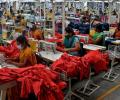
The share of women workers in registered factories submitting annual returns - working more than the statutorily-mandated maximum limit of 48 hours in a week - increased to a 11-year high of 33.6 per cent in 2019, shows the latest annual data released by the labour bureau. In comparison, only 27.9 per cent male workers worked more than the statutorily-mandated hours. Earlier in 2008, 39.2 per cent women workers had worked more than the prescribed work time.

Modi is keen to get more investments into Gujarat.
 © 2026 Rediff.com - Advertise with us - Disclaimer - Privacy Policy - Sitemap - Feedback - About us - Terms of use - Grievances